
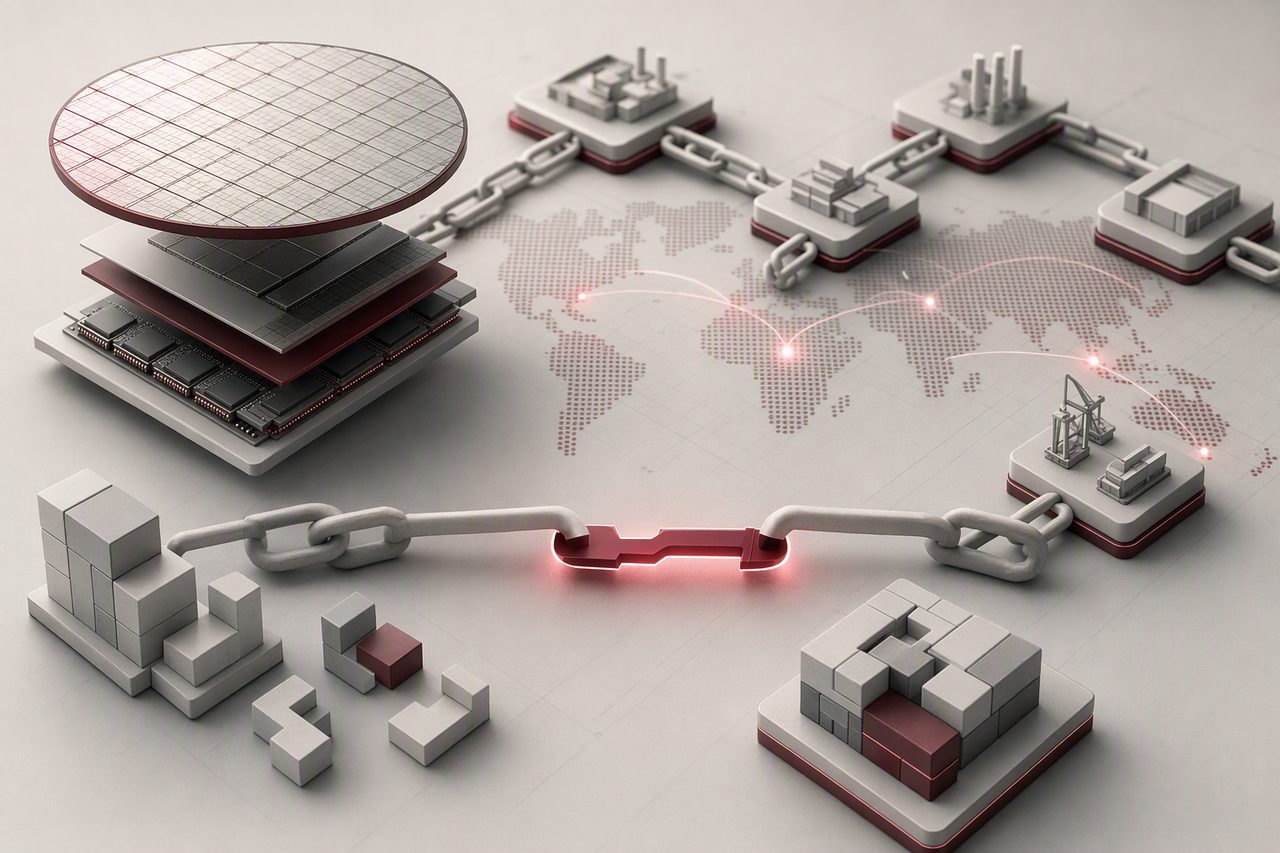
News about semiconductors may seem far removed from the day-to-day life of a distribution company in the Balearic Islands or a retail chain on the mainland. But they are not so distant: the chip shortage ends up reaching the IT budget in the form of longer lead times, more expensive equipment and postponed renewals. The latest signal came from TechCrunch on 16 September 2026, reporting —citing a prior report by Reuters— that SK Hynix is reportedly negotiating with Intel to manufacture memory chips in the United States for the first time.
What has been published (and what is not confirmed)
According to that report, the two companies are said to have discussed several options: SK Hynix renting space at Intel’s future plant in Ohio, or even a joint venture that cloud service providers could join. SK Hynix itself told TechCrunch that nothing is closed: it is "exploring options to strengthen its global competitiveness", with no finalised plans or agreements.
The context, however, is solid. SK Hynix has been growing strongly thanks to demand for high-bandwidth memory (HBM) for AI data centres, and is already building an advanced packaging and research plant in West Lafayette (Indiana), with mass production expected in 2029. At the same time, the US administration is pushing to manufacture more chips on its territory, with tariffs on semiconductor imports on the table and relief for those who invest there. And the move itself could require review in South Korea, as it involves strategic technology.
Translation for the business reader: the memory supply chain is being reorganised for geopolitical reasons and because of AI demand. That means less predictable prices and less reliable lead times for some time.
How the chip shortage is felt in an SME
You don’t need to buy silicon wafers to suffer from it. We see it in very concrete things:
Equipment lead times and prices
Laptops, servers, POS systems, warehouse radio-frequency terminals, worker tablets or access control cameras: all of that contains memory. When the market tightens, lead times stretch and the price of the same reference rises between one quote and the next.
Projects that get blocked "because of hardware"
This is the most expensive effect and the least visible: digitalisation projects postponed because "first we have to renew the equipment". Very often that dependency is more assumed than real.
Cloud and AI costs
The same memory that is in short supply feeds AI data centres. It is worth reviewing the cloud and AI services bill with the same discipline used for the energy bill, and sizing projects by the value they deliver, not by enthusiasm.
Four practical decisions in the face of the chip shortage
1. Separate what depends on hardware from what does not
Make a list of the initiatives that are on hold and mark them: do they really need new hardware, or is software, integration and processes enough? In our experience, a good part of management improvements —automating delivery note capture, tidying up inventory, giving visibility of margin per customer, digitalising work reports— does not require a single new device. That is the work that can move forward while the market returns to normal.
2. Squeeze the software before buying equipment
A slow terminal is not always an old terminal: sometimes it is a poorly designed process. Before renewing devices, it is worth checking whether the application asks for data nobody uses, whether the operator enters the same information three times, or whether there are screens designed for a workflow that changed years ago. With Power Platform (Power Apps, Power Automate, Power BI) or with custom development on top of the ERP, those flows can be simplified and the existing equipment pool put to better use.
3. Extend the useful life sensibly, not out of inertia
Stretching equipment makes sense when it comes with a plan: prioritise the renewal of what is critical (production servers, checkout stations, warehouse terminals), move to the cloud whatever brings flexibility, and apply a reasonable cybersecurity baseline, because an old, unsupported device is a risk, not a saving.
4. Choose AI projects by measurable use case
AI demand is precisely what is straining the memory market. All the more reason not to rush into "doing AI" as a fashion: define a specific use case, with an indicator you can measure (administrative hours saved, order errors, response time to a customer) and then assess whether to scale it. That is the approach we work with: identify the relevant data, organise its governance and execute a use case tailored to the business.
Where custom development fits in
When equipment is the bottleneck, well-built software is the fastest lever. Some examples of the kind of work we do in the custom development line:
- Integrations between the ERP and e-commerce, banking, POS or a supplier’s systems, to eliminate manual re-entry of data.
- Simple mobile applications that run on the devices the workforce already has.
- Automation of repetitive administrative processes with Power Automate.
- Dashboards in Power BI to decide with data and not with intuition.
- Extensions on Business Central, including our verticals for hotels, retail, distribution, sports centres and fleets.
Since 1987 we have been supporting private companies in retail, distribution, construction, the food industry, services and automotive, as a Microsoft Partner and ISV. And one lesson repeats itself across all those years: hardware cycles come and go, but well-digitalised processes stay.
Conclusion: what you don’t control and what you do
Whether SK Hynix and Intel reach an agreement in Ohio or not is out of your hands. What is in your hands is deciding which projects move forward now without depending on supply, which equipment is truly critical and which processes you can simplify this quarter with the software you already pay for.
Would you like a no-obligation assessment of your situation? Tell us what you have on hold and why: write to us at info@grupotisa.com or call us on (+34) 971 305 885. You will find more information about our services and success stories at grupotisa.com.
Source of the news: TechCrunch, "SK Hynix reportedly in talks with Intel to build memory chips in US" (16 September 2026), based on a Reuters report. Neither of the two companies has confirmed an agreement.