
In late 2026, SAP announced that the consulting firm IDC had recognised it as a Leader in several IDC MarketScape assessments dedicated to supply chain planning: the general one and those specific to process industries, life sciences, discrete manufacturing and consumer goods (source: news.sap.com, November 2026). At first glance it looks like news only for multinationals. At Tisa we read it differently: the underlying problem that report describes —making fast, context-aware decisions when everything is changing— is suffered in exactly the same way by a 40-person distribution company in the Balearic Islands.
What’s interesting isn’t the recognition, it’s the map
IDC’s assessments score each vendor on two axes: capabilities (product and short-term execution) and strategy (fit with what the customer will need in three to five years). But the detail that catches our attention most is another one: IDC doesn’t publish a single report, but several by sector. There’s one for process industry, another for discrete manufacturing, another for consumer goods, another for distribution.
That confirms something we repeat in every project: "planning" doesn’t exist in the abstract. A food manufacturer thinks in terms of batches, expiry dates and traceability. A building materials distributor thinks in terms of multi-warehouse, supplier lead times and recurring orders. A retail chain thinks in terms of store-level replenishment and seasonality. If the tool doesn’t understand that context, the plan it produces looks nice on paper and is useless on the loading dock.
Why supply chain planning is also an SME matter
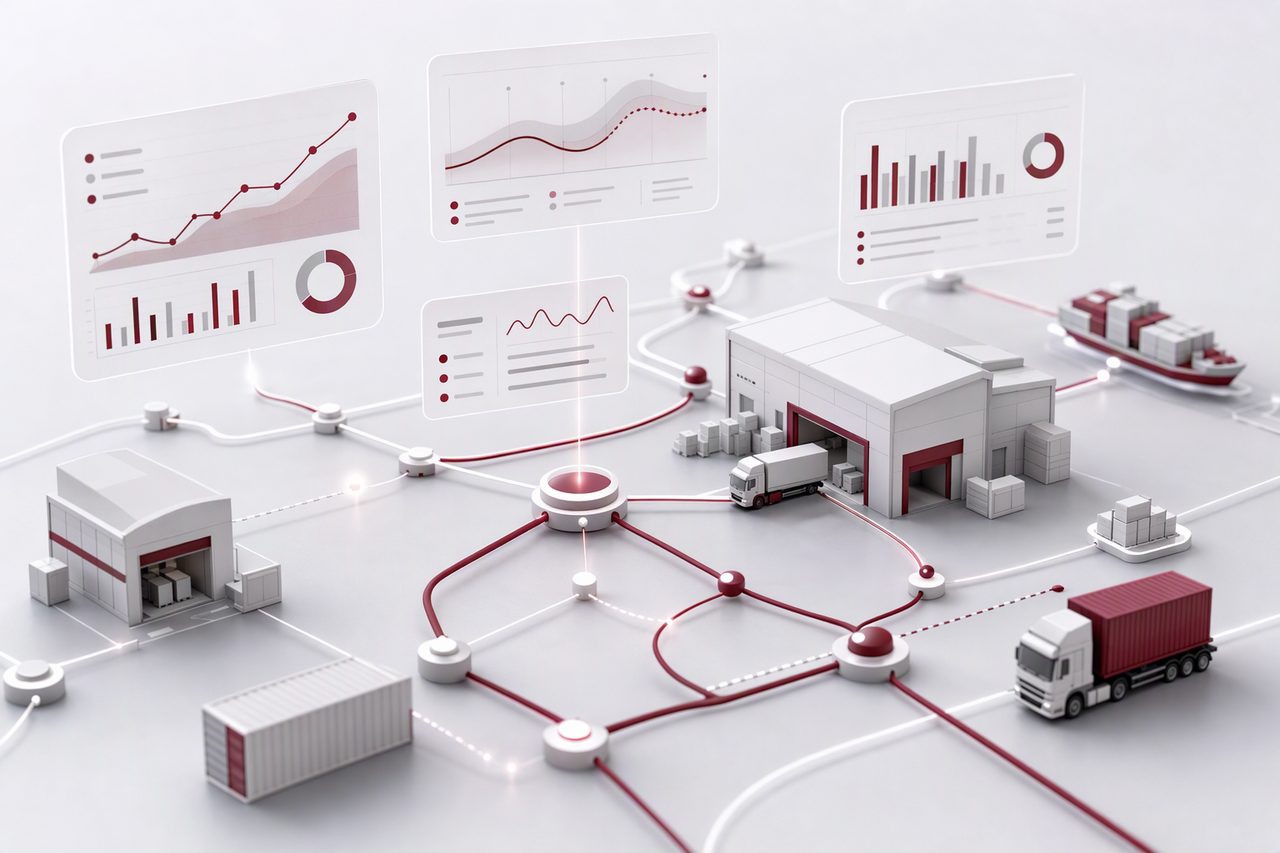
The conversation the big software vendors are having revolves around a simple idea: planning and execution can’t go separately. A change in demand affects inventory, production, purchasing, transport and, in the end, the margin. When those pieces live in different systems —or in different spreadsheets— each area optimises its own part and the whole loses out.
In an SME, that divorce isn’t called "lack of orchestration". It’s called:
- A salesperson promising a delivery date that nobody has confirmed with the warehouse.
- Purchasing placing orders "just in case" because they don’t trust the system’s stock figures.
- Product sitting idle for months while the items that actually turn over run out of stock.
- A monthly close in which you discover the problem six weeks too late.
- Two or three master spreadsheets that only the person who maintains them understands (and who will retire one day).
If you recognise three or more of those symptoms, you don’t have an advanced planning tool problem: you have a data and process problem that no AI is going to solve for you.
The right order: data, processes and then AI
The message from the major vendors is that artificial intelligence makes it possible to detect patterns, simulate scenarios and automate planning tasks. That’s true, and it’s where the market is heading. But it’s worth reading the small print: that intelligence only adds value if it rests on connected processes and reliable data.
That’s why, when a company asks us about AI applied to its supply chain, we start with rather unglamorous questions. Does the ERP inventory match the warehouse? Are each supplier’s lead times and minimum batch sizes properly maintained? Do you have clean sales history with enough depth? Who decides what counts as correct data? That last question is data governance, and it is the foundation of any AI project that aims to last longer than a demo.
SAP’s article cites customer results such as a 50% reduction in manual planning processes or 40% less excess inventory
What you can put into practice today with Business Central
At Tisa we implement Microsoft Dynamics 365 Business Central, which covers eight functional areas, including supply chain, purchasing and inventory, manufacturing and business intelligence. For most industrial and distribution SMEs, that covers 80% of the journey:
A single version of stock and demand
Sales, purchasing, warehouse and finance working on the same data. It sounds basic and it remains the biggest leap in value we see in projects.
Verticals for what the standard doesn’t cover
As an independent developer on Business Central, we have built our own extensions. The one for distribution and dealer centres includes multi-warehouse control, inventory, automatic orders and configurable reports: exactly the kind of automation that eliminates repetitive purchasing decisions.
Dashboards that people actually look at
Power BI on top of the ERP data to see turnover, coverage, stockouts and margins without exporting anything by hand.
AI when the ground is ready
Microsoft is incorporating Copilot within its Dynamics and Power Platform ecosystem
How to start without a pharaonic project
- Choose a measurable pain point. For example, reducing stockouts in the 50 items that generate the most revenue. A clear objective is worth more than a three-year transformation plan.
- Audit the data for that product family. Lead times, minimum stock levels, history. If the data is dirty, clean it before automating anything.
- Automate one decision, not all of them. Automatic order proposals, reviewed by a person during the first few months.
- Measure and scale. With a result in hand, the next step defends itself before management.
That’s the sequence we have followed with clients in retail, distribution, construction, the food industry, sports centres and fleet management. You can see an overview in our success stories.
Conclusion: what matters isn’t who leads the quadrant
The fact that SAP stands out in IDC’s reports is a good sign of where the market is heading: planning and execution connected, by sector and with AI on top. The useful question for you isn’t which vendor leads, but whether your company is able to detect a change in demand and respond in days instead of weeks.
If supply chain planning in your company still depends on three spreadsheets and the memory of two people, let’s talk. At Tisa we have been helping private companies organise their management with Microsoft technology since 1987, and we offer you an initial assessment with no obligation: call us on (+34) 971 305 885 or write to us at info@grupotisa.com.