
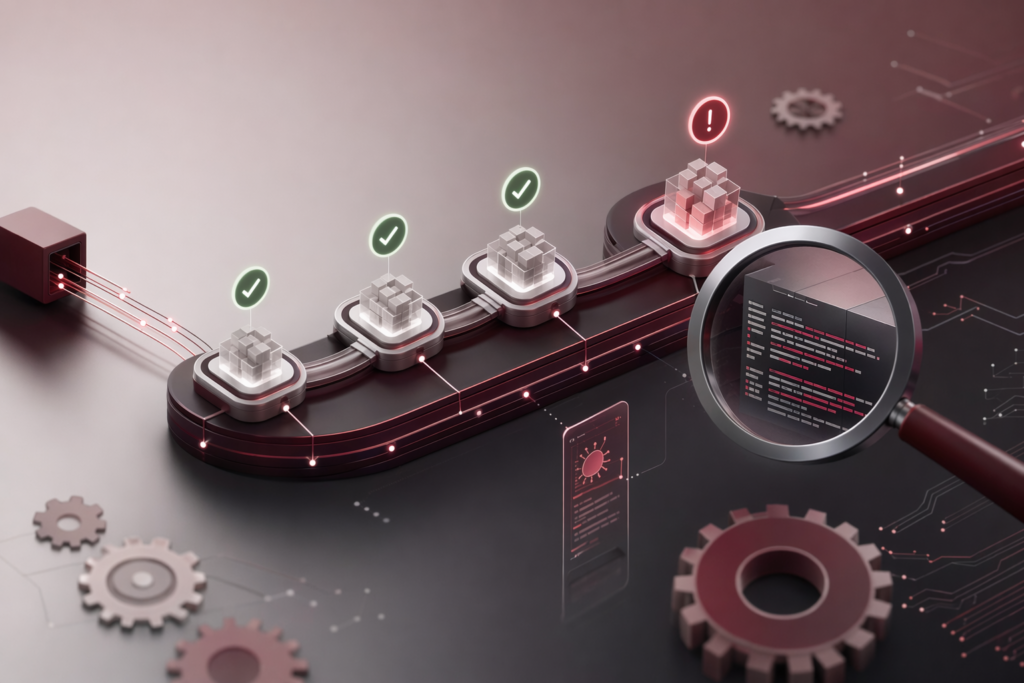
When we think about artificial intelligence, we almost always imagine a chat window: we type a question and receive an answer. It’s useful, but it’s just the tip of the iceberg. The real leap comes when AI stops waiting for someone to write to it and starts to act within your systems. That’s where MCP in continuous integration comes into play: using an assistant connected to your tools so it can review, understand and diagnose the failures of your builds automatically, without a developer having to stop everything to investigate.
In this article we explain, without hype, what MCP is, why it makes sense to take it "beyond the chat" and how a custom development project can turn it into a real improvement in your technical team’s productivity.
What MCP is and why to take it out of the chat
MCP stands for Model Context Protocol, an open standard promoted by Anthropic
In other words: instead of copying and pasting a log into a chat so the AI can "give an opinion", the model accesses the source directly, with controlled permissions, and works on real information. That nuance changes everything. We go from an assistant that answers to an assistant that executes multi-step tasks using tools, which in the industry we call an AI agent.
Taking AI out of the chat window means integrating it into the flows where the work really happens: your processes, your automations and —the case we are dealing with today— your continuous integration.
What MCP in continuous integration brings
Continuous integration (CI) is the practice of building and testing code automatically every time someone makes a change. When everything goes well, it’s invisible. The problem appears when a build fails: someone has to open the execution log, read hundreds of log lines, identify the cause and decide what to do. That consumes time, interrupts developers and slows down deliveries.
This is where MCP in continuous integration brings concrete value. An agent connected via MCP can:
- Read the failed build’s log as soon as it occurs, without manual intervention.
- Cross-reference that information with the repository history, recent changes and previous executions.
- Propose a hypothesis of the root cause in clear language: a broken dependency, a test that fails due to a specific change, a misconfigured environment variable.
- Suggest a fix or open an alert to the right person with the context already summarized.
The result is not "magic": it is intelligent automation, that is, combining the process automation of always with AI’s ability to interpret texts and situations that previously required human judgment.
Build diagnostics: a realistic example
Imagine a team that deploys updates several times a week. On a Friday afternoon, the build fails. Without AI, the on-call developer spends half an hour diving into logs to discover that the failure comes from an updated library that broke a test.
With an agent integrated via MCP, the system detects the failure, analyzes the log, relates it to the latest dependency change and posts a message in the team’s channel along the lines of: "Build #482 has failed. Probable cause: the update of library X breaks test Y. Responsible change: commit at 17:14. Suggestion: pin the previous version or adapt the test."
The developer no longer starts from scratch: they start from a contrasted hypothesis. That is recovered time and less frustration.
Business benefits, not just technical ones
It’s easy to stay in the technical realm, but what matters to a company are the results. Bringing AI to continuous integration translates into measurable advantages:
- Less time lost on repetitive manual diagnostics.
- Faster and more predictable deliveries, because failures are identified sooner.
- Fewer errors that reach production, by detecting the cause at the right stage.
- Knowledge that isn’t lost: the context of each incident is documented and summarized.
- Technical teams more focused on building value and not on putting out fires.
For an SME, this is not about "having AI for the sake of having AI", but about a use case adapted to the business: a concrete, measurable problem with a clear return.
Risks and best practices
No serious AI project is undertaken without talking about its limits. A model can hallucinate, that is, generate an explanation that seems correct but isn’t. That’s why the AI’s diagnosis should be treated as a supporting hypothesis, not as an automatic truth: the final decision still belongs to the team.
In addition, giving an agent access to your code and your systems requires governance: minimum necessary permissions, traceability of what it does and security controls. Connecting AI to reliable and bounded information (for example, through techniques such as RAG, which anchor it to verifiable data) reduces the risk of made-up answers. Well planned, you gain productivity without losing control.
How TISA puts it into practice
At Tisa we have been helping private companies and SMEs modernize their technology since 1987, and our custom development line exists precisely for cases like this: we don’t sell a fad, we design the solution that fits your processes. We combine automation, systems integration and Power Platform to connect your tools and take AI where it brings real value, always with a practical approach and with an eye on the return.
If your team loses hours diagnosing failures, if your deliveries get stuck or if you simply want to explore what AI applied to your technical operations can do, the first step is an honest conversation about your specific case. We assess with you whether MCP in continuous integration makes sense for your company and how to start with a small, measurable use case without unnecessary risks.
Shall we talk? Request a no-obligation assessment at (+34) 971 305 885, write to us at info@grupotisa.com or visit grupotisa.com. We help you take artificial intelligence out of the chat window and put it to work for real.